

How does website speed boost SEO optimization?

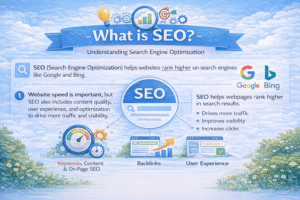
Best SEO Strategy Website speed is one of many factors involved in the discipline of search engine optimization (SEO), but it is not the only one. SEO is the practice of tailoring content and website experience to how search engines like Google and Bing evaluate webpages and rank them in search results. The goal of SEO is to rank pages as highly as possible in search results, which ultimately drives more traffic to a website.
From a search engine’s perspective, it is important to make it easy for users to find the information they need, so a website’s user experience is very important.
How Much Does Site Speed Affect SEO in 2026?
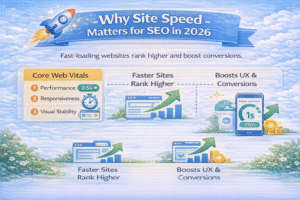

Google now evaluates page performance through Core Web Vitals, which measure real-world user experience based on:
- Largest Content Paint (LCP) – loading performance
- Interaction to Next Paint (INP) – responsiveness (replaced FID in 2024)
- Cumulative Layout Shift (CLS) – visual stability
Websites that load quickly and provide smooth interactions are more likely to rank higher in search results.
Although Google does not publicly disclose the exact weight of speed in its ranking algorithm, performance optimization is clearly essential. A slow website increases bounce rates, reduces user satisfaction, and negatively affects conversions.
Mobile performance is especially important. Recent studies show that more than half of users abandon a website if it takes longer than 3 seconds to load. Since Google uses mobile-first indexing, optimizing speed for smartphones is now more critical than ever.
Why Site Speed Matters in 2026:
Improves Core Web Vitals scores
Reduces bounce rate
Increases average session duration
Boosts conversions
Enhances mobile SEO performance
Improves crawl efficiency for search engines
In short, site speed is no longer just a technical improvement — it is a fundamental SEO requirement in 2026.
SEO fundamentals
How does SEO work?
When a user performs a search, the search engine generates a list of websites that are put in order from most likely to least likely to fulfill the query. This list is typically divided into a series of results pages (or SERPs) listing websites that may answer the user’s query, and usually there are 10 results per SERP. Best SEO Strategy Most users will not go past the first page of search results, opting instead to refine their search and try again. For this reason, the goal of most SEO experts is to get the website they are managing into the top 10 search results for the queries they are targeting.
A website will rank higher or lower in search engine results depending on a number of factors, including how relevant it is for the query and how authoritative the search algorithm considers the website to be. By optimizing a website for search, website owners can make sure their content shows up as high as possible in search rankings, making it more likely that users will click.
SEO functions as a collection of practices for helping search Best SEO Strategy engines determine what kind of information is offered on a website, and by extension, enabling users who are looking for that information to find it.
In the West, Google dominates the search engine market, and because of this Google’s algorithms are largely what determine SEO best practices. In North America, Google has close to 90% of all searches, with Bing and Yahoo search taking up most of the rest of the market. However, in other parts of the world, other search engines hold sway; for instance, Baidu is the main search engine in China.
SEO encompasses a variety of tactics, including:
- Content quality: relates to how well a piece answers the questions users raise in search. Practitioners use a process called keyword research to ensure topics and search terms are worth pursuing. Keyword research involves understanding search volume, related search terms, and the competitive landscape for a keyword. Additionally, the quality of a piece relates to how well a piece matches user intent Best SEO Strategy — or helps the user accomplish whatever goal landed them on that page. Best SEO Strategy For example, a piece titled “what is SEO” should focus on defining SEO and explaining its relevant components, while a piece titled “how to optimize SEO” should focus on actionable advice.
- On-page factors: refer to how the webpage content is structured. Optimized webpages have clear and direct titles, helpful section headers, descriptive file names and alt tags for images, and easy-to-understand site hierarchies. These factors make it easy for search engines to “understand” what a webpage is about.
- Off-page factors: on the other hand, are outside of the content on the website itself. One of the most common off-page factors is the amount of external links a website has. When authoritative (or trusted) websites link to content outside of their website, the Google algorithm interprets Best SEO Strategy that as an indication the content is valuable.
- User experience: focuses on the website visitor and is where core web vitals (CWVs) come into play. The CWVs are a set of metrics Google uses to measure how quickly and smoothly items on a webpage load and in turn, how users experience the site. Best SEO Strategy While CWVs matter for any website, they may be particularly critical for certain industries, like ecommerce. For example, when someone is trying to check out from an online shoe store, slow page speed could be the difference between $100 in revenue and $0.
Some website owners opt to use problematic tactics called “black hat” SEO, but these are generally not recommended. One of the most well-known techniques is called keyword stuffing.
Keyword stuffing is the practice of using keywords multiple times in content to an unnatural degree to gain an advantage in search engine rankings. Google no longer considers the frequency with which keywords are used to be relevant and sometimes penalizes sites for clear instances of keyword stuffing.
Why is SEO important?
SEO is critical to a holistic marketing strategy, partially because having relevant content that ranks highly is good for a company’s authority in their chosen industry.
Additionally, SEO is an organic or unpaid marketing tactic. While it may require time and effort to optimize a piece of content or optimize the user experience, the traffic SEO efforts garner is not something that can be bought. Compare this to digital ads, which disappear as soon as a company Best SEO Strategy stops paying for them. In this sense, SEO efforts may have more long-term benefits compared to pay-to-play tactics.
SEO can also help companies build an audience of future buyers. For example, if an ecommerce company that sells sunscreen wants to drive potential customers to their site, they can pay to have their website appear as an ad on other websites. But that will only capture some potential buyers. Someone who searches on Google, “what are the benefits of wearing sunscreen” may also be a potential customer, but could be unlikely to click or see an ad. A holistic marketing strategy will have tactics to make both of these types of customers familiar with their brand and eventually convert them into buyers. SEO should be part of that strategy.
How do I optimize my web page for SEO?
Content and keyword research
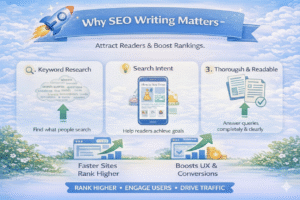

Understand and write for search intent: All readers have a goal in mind when they read or visit a webpage, whether they are consciously aware of it or not. Site owners should think about how to best help their readers accomplish their goals. For example, a reader who visits an article about how to sew a dress is looking for something instructive and actionable. A site owner may want to supplement their article with a video demonstration or images of the process to make it easier for the reader to follow along.
Write thorough, easy to understand pieces: Google will rank the pieces it believes best answers search queries. One way to give pieces the best shot to rank is for site owners to ensure they cover as much of a topic as relevant for the reader’s goals. Additionally, writing pieces that are easy for readers to understand can help boost SEO as well, because readability is another ranking factor.
How can Cloudflare help with SEO?
Cloudflare offers a few tools for boosting site speed, which can improve technical SEO. Cloudflare CDN improves website performance by caching static and dynamic content across a global network spanning more than 330 cities in over 125 countries. Additionally, Cloudflare Images offers resizing functionality that can compress images and further increase website loading speed.