
Identify the Right Keywords and Determine Whether They are Relevant and Effective? Identifying 2026 Trending Roles & Trends
1.Identifying the Right Keywords (Brainstorming)
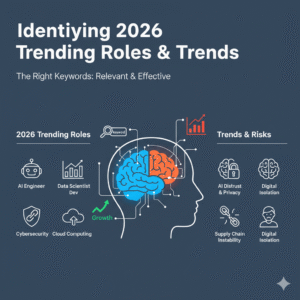 The “right” keywords are not always the ones with the highest search volume. They are the ones that match user intent—what someone actually wants to find. Identify the Right Keywords and Ensure
- Start with Seed Keywords: List 5-10 broad topics related to your business or job role (e.g., “digital marketing,” “data analysis,” “content strategy”).
- Use Tools for Expansion: Input your seed keywords into tools like Google Keyword Planner, SEMrush, Ahrefs, Ubersuggest, or AnswerThePublic.
- Focus on Long-Tail Keywords: Look for specific, longer phrases (e.g., “best SEO strategy for SaaS,” “junior data analyst resume”). They have lower volume but higher conversion potential.
- Analyze Competitors: See what keywords your competitors are ranking for Identify the Right Keywords and Ensure.
2.Determining Relevance (Do they match the intent?)
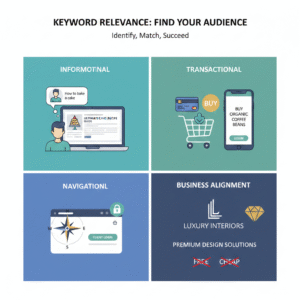 A keyword is relevant if it directly matches the service, product, or role you are describing. If your content doesn’t answer the searcher’s question, the keyword is irrelevant. Identify the Right Keywords and Ensure.
- Search Intent Check: Type your keyword into Google. Are the top results articles, product pages, or videos?
- Informational: “How to…”
- Transactional: “Buy…” or “Price of…”
- Navigational: “Login…”
- Business Alignment: Does this keyword directly help your target audience find your specific solution?
- Remove Irrelevant Terms: If you are a high-end service provider, a keyword like “free” or “cheap” is irrelevant, even if it has high volume Identify the Right Keywords and Ensure.
3. Determining Effectiveness (Will they bring results?)
An effective keyword is relevant and capable of bringing qualified traffic,, without being too difficult to rank for Identify the Right Keywords and Ensure .
- Search Volume: High enough to matter, but not so high that you can’t compete.
- Keyword Difficulty (KD): A score indicating how hard it is to rank. Lower is better, especially for new sites.
- Conversion Potential: Does the searcher want to take action (buy, sign up), or just browse?
- Cost Per Click (CPC): In PPC, a high CPC indicates strong commercial intent (the keyword drives money.
Content Overview
No. Section Title Description 1 Introduction Overview of keyword research and 2026 job market trends 2 Understanding Keyword Research Basics What keywords are and why they matter for SEO 3 Types of Keywords Short-tail, long-tail, transactional, informational, and trending keywords 4 How to Identify the Right Keywords Tools, competitor analysis, and search intent research 5 Evaluating Keyword Relevance Matching keywords with audience needs and business goals 6 Measuring Keyword Effectiveness Search volume, competition level, CTR, and conversion rate 7 Common Keyword Research Mistakes Keyword stuffing, ignoring intent, and outdated terms 8 Introduction to 2026 Trending Roles Overview of future-focused job roles 9 AI & Automation Dominated Roles AI Engineer, Data Scientist, Machine Learning Specialist 10 Emerging Tech-Based Careers Blockchain Developer, Cybersecurity Analyst, Cloud Architect 11 Digital & Marketing Trends 2026 SEO Strategist, Performance Marketer, AI Content Specialist 12 Skill Shifts in 2026 High-demand technical and soft skills 13 Tools to Track 2026 Trends Trend analysis platforms and job market research tools 14 Aligning Keywords with 2026 Trends Combining SEO strategy with future career opportunities 15 Conclusion Final thoughts on strategic keyword planning for 2026
Advantage
Targeted Traffic
When the right keywords are used, only people who are genuinely interested in your business visit your website. This increases quality leads.
Higher Search Ranking
Proper keyword research helps a website rank higher in search engines. Tools like Google Keyword Planner support effective keyword selection.
Better Conversion Rate
Using relevant keywords increases the chances of converting visitors into customers.
Cost-Effective Marketing
Choosing the correct keywords prevents wasting money on the wrong audience and helps save the marketing budget.
Easy Performance Tracking
Keyword performance can be measured using tools like Google Analytics and Google Search Console.
Disadvantages
Time-Consuming Process
Keyword research and analysis require significant time and effort.
High Competition
Some high-volume keywords have intense competition, making it difficult to rank.
Continuous Monitoring Required
Selecting keywords once is not enough. Regular updates and optimization are necessary.
Risk of Incorrect Analysis
If the wrong keywords are chosen, traffic may increase, but conversions may not.
Algorithm Changes
Search engine updates can affect rankings, which may impact keyword performance.
Key Challenges in Keyword Research and Performance Analysis
High Competition
Popular keywords often have very high competition, making it difficult to rank on search engines. This is especially challenging in competitive industries like BPO and digital marketing, where strong competitors are already targeting the same keywords.
Changing Search Trends
Search behavior changes regularly. It is important to track trends using tools like Google Trends. If keywords are not updated according to current trends, they may become outdated and less effective.
Understanding User Intent
It is important to understand whether the user is searching for information or looking to hire a service. If user intent is misunderstood, the website may attract the wrong audience, resulting in low conversions.
Data Accuracy Issues
Keyword research tools do not always provide 100% accurate data. For example, Google Keyword Planner often shows estimated or approximate search volume data.
Continuous Monitoring Required
Selecting keywords is not a one-time task. Regular performance tracking is necessary using tools like Google Analytics and Google Search Console.
Algorithm Updates
Search engine algorithms are frequently updated, which can affect keyword rankings. Therefore, strategies must be continuously updated to maintain performance. Identify the Right Keywords and Ensure.
Identifying 2026 Trending Roles & Trends
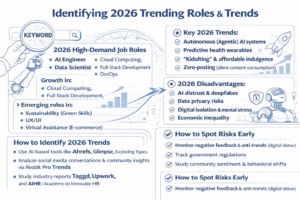 2026 High-Demand Job Roles
- AI Engineer, Data Scientist, Blockchain Developer
- Growth in Cloud Computing, Cybersecurity, Full-Stack Development, DevOps
- Emerging roles in Sustainability (Green Skills), UX/UI, Virtual Assistance (E-commerce)
- How to Identify 2026 Trends
- Use AI-based tools like Ahrefs, Glimpse, and Exploding Topics
- Analyze social media conversations & community insights via Reddit Pro Trends
- Study industry reports from Taggd, Upwork, and AIHR | Academy to Innovate HR
- Track AI evolution like Agentic AI, in-app shopping, and social-first video commerce.
- Key 2026 Trends
- Autonomous (Agentic) AI systems
- Predictive health wearables
- “Kidulting” & affordable indulgence
- Zero-posting (silent content consumption)
- 2026 Disadvantages
- AI distrust & deepfakes
- Data privacy risks
- Digital isolation & mental stress
- Economic inequality
- Supply chain instability
- How to Spot Risks Early
- Monitor negative feedback & anti-trends (digital detox)
- Track government regulations
- Study community sentiment & behavioral shifts